

Let's KEEP talking about money in the arts
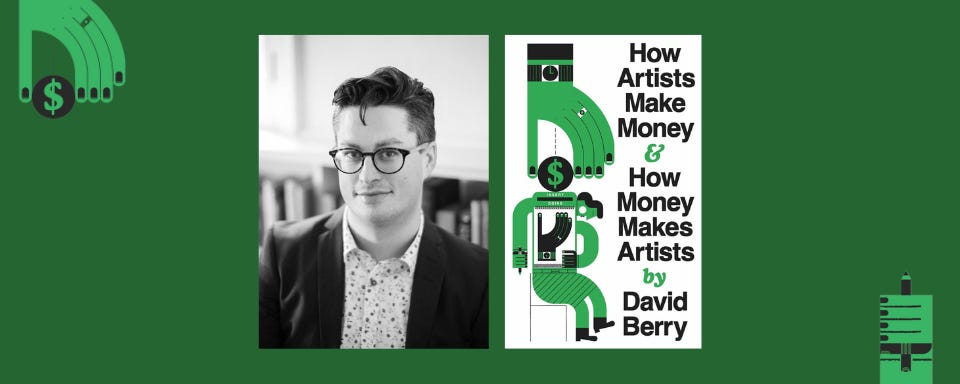
An interview with David Berry, author of How Artists Make Money & Money Makes Artists

I think a lot about how to avoid a scarcity mindset, specifically in the art world, where opportunities are finite. A scarcity mindset leads to the worst things: missed opportunities, competitiveness rather than collaboration, and decisions made out of perceived scarcity rather than trusting your gut.
As I’m writing this, I’m really just telling it to myself.
Anyway! As part of the inaugural book club, where we’re reading How Artists Make Money & Money Makes Artists by David Berry, I called Berry to ask him some questions, starting with:
Tatum Dooley: In our Substack chat, artists have been discussing how steady employment can allow more freedom in making art, free from market pressure. What are your thoughts?
David Berry: One of my conclusions is that it’s completely fine to have something that pays your bills so you can make the art you want. Time and energy are factors, of course. But in my experience with freelance journalism, the compromises required to make it financially viable drained the joy from it. If you’re already compromising, you might as well do it in an area unrelated to your creative work. Then you can protect that creative space.
Someone once asked why I don’t just write more market-friendly books to subsidize what I care about. My response was: if I’m going to compromise, why not do something with a paycheque and pension? Why remain in the same precarious system? That’s where I’ve landed.
In other words: Protect your creative practice.
We’ll be meeting next Monday (March 2nd) at 6 PM ET to discuss this book and making money in the arts. (Originally, the virtual book club was going to be this Friday at 7 pm, but I received a few messages that this time didn’t work, which, in retrospect, is obvious!).
⬇️⬇️⬇️
Here’s a link to the Google Meet where we’ll be convening to discuss!
⬆️⬆️⬆️
Read the interview with David Berry below—we chat about how to be more honest about money, giving advice to young people entering the field, and how the ego of artists has been present through the centuries.

Tatum Dooley: At the beginning of the book, you start with the question of how artists make money. I’m wondering if there was a single impetus behind writing it. Was there something in your personal life, or a particular story, that sparked the idea?
David Berry: Selfishly, it came out of my own life. I published my first book in 2020. It was supposed to come out in April 2020 and then got delayed, for obvious reasons. I got a firsthand look at how much money is actually involved. At first, I thought maybe I just did a bad job, and my book didn’t sell well. But when I looked into it more, I realized I’d actually done fine, especially as a Canadian debut author without any celebrity behind me. That led me to wonder how anyone makes this work when it’s barely even viable as a side gig.
Later in the pandemic, there was a lot of discussion about inequities in the art world. The pandemic didn’t create those problems, but it exposed them. It seemed like many people were thinking about this and trying to figure out how to keep going. That’s what led me down the path of the book.
TD: I was struck by your decision to share your own financial details so transparently. We don’t often talk about money. Was that a difficult choice?
DB: Yes, it was difficult. But part of the impetus for the book was the belief that we need to be more forthright about this. There’s a strange irony: we value honesty and authenticity in art, yet we avoid talking about money. People will write about deeply personal experiences, but money is still taboo.
Originally, I planned to interview working artists about their finances. But I realized I couldn’t always trust people to be fully open. Sometimes someone seemed forthright, and later I’d learn they were connected to significant wealth. They weren’t lying, exactly, but they weren’t telling the full story either. Eventually, I concluded that the only person I could fully rely on was myself. I know my situation, and I can try to be honest about it.
It was harrowing. There’s shame on all sides: wondering if I was bad at negotiating, or whether I’d reveal privilege I hadn’t fully earned, through marriage or family connections. From every angle, it felt fraught. But I thought it was necessary. Art is supposed to explore the difficult things we don’t otherwise know how to talk about.
TD: You mentioned that artists aren’t fully honest about money. I’ve had similar experiences where someone presents one story, and then you learn more about their background. It makes me think about self-mythology and how that connects to money. The narrative of the starving artist who perseveres is compelling. It creates a better arc.
DB: Absolutely. We value that narrative, the struggling artist who succeeds through brilliance and perseverance. It’s the story we’re most comfortable telling. But it’s also tied to the idea that art’s worth is measured by financial success. If your art hasn’t made money, it’s somehow deficient.
Keep reading with a 7-day free trial
Subscribe to Art Forecast to keep reading this post and get 7 days of free access to the full post archives.